
What is a Prop Firm? Complete Guide to Proprietary Trading 2026
Complete guide to prop firms: what is proprietary trading, how it works, top firms 2026, risks, and strategies for success. Discover prop trading - trade $100K+ funded accounts keeping 80-90% profits with zero personal risk.

The proprietary trading industry has exploded in 2026, with an estimated 2.5 million retail traders participating globally. If you have been exploring the financial markets, you have likely heard the term “prop firm” thrown around constantly. But what exactly is it, and why is it transforming the lives of retail traders? This article will help you fully understand prop trading from the ground up, whether you are a complete beginner or an experienced trader looking to scale.
01. The Core Definition of Proprietary Trading
A prop firm, short for proprietary trading firm, is a company that provides its own corporate capital to independent traders, allowing them to trade financial markets such as forex, futures, stocks, and crypto. In return for utilizing the firm’s money and infrastructure, the trader agrees to a performance-based profit-sharing model where they keep anywhere from 70% to 90% of the net profits they generate.
This model is a massive paradigm shift from traditional finance. Historically, to trade six or seven figures of capital, you needed a degree from a top-tier university, a job on Wall Street, and access to institutional hedge funds. Today, proprietary trading firms have democratized access to institutional capital. Anyone with a stable internet connection, regardless of their geographic location, background, or personal wealth, can prove their skills and gain access to life-changing amounts of money to trade.
Your only upfront financial cost is a one-time evaluation fee. This fee grants you access to a simulated challenge environment designed to prove your trading skills, emotional discipline, and risk management prowess. The evaluation ensures that the firm only entrusts its real capital to traders who have a proven, statistical edge in the market.
“The true value of a proprietary trading firm is not just the capital it provides, but the psychological freedom it grants a trader by eliminating the fear of personal financial ruin. You can trade clearly knowing your downside is strictly capped.” - Alexander Mercer
02. The Difference Between Retail Brokers and Prop Firms
Unlike a traditional retail broker-where you are required to deposit your own hard-earned personal capital to trade-a prop firm completely removes personal financial risk from the equation. If you lose money on a personal broker account, you suffer a direct, painful financial hit. This constant fear of losing personal savings often leads to emotional trading, widening stop losses, and poor decision-making.
In a prop firm model, if you successfully pass the evaluation and are granted a funded account, any losses incurred (within the strictly defined allowed drawdown limits) are absorbed 100% by the corporate firm. You are never in debt to the firm, and you never have to deposit more money to cover bad trades. This structural difference completely alters a trader’s psychology.
When you trade a funded account, you are acting as an independent B2B signal provider. The firm is compensating you for your data and performance. If you fail, the only thing you lose is the initial evaluation fee, making it the most asymmetrical risk-to-reward ratio available in the financial markets today.
03. The Evolution of Prop Trading in 2026
The industry has matured significantly since its inception. Gone are the days of rigid 30-day time limits to pass a challenge, trailing drawdowns that punished profitable traders, and obscure rules hidden deep within terms of service. In 2026, the landscape is defined by “Unlimited Time” challenges, significantly better payout structures, and a much higher degree of corporate transparency.
Firms have realized that forcing traders into artificial time constraints only encourages high-risk gambling behaviors, whereas unlimited time encourages the patient, risk-averse trading that genuinely protects corporate capital over the long run. Furthermore, the technology has evolved. Firms now provide comprehensive analytical dashboards, integrated economic calendars, and automated risk management tools to help traders succeed. The focus has shifted from simply collecting evaluation fees to actively retaining profitable traders and building long-term, mutually beneficial relationships.
04. How the Evaluation Phases Actually Work
To get funded by a proprietary trading firm, you cannot simply ask for money; you must prove that you can protect capital. This is done through a rigorous, simulated evaluation process designed to test every aspect of your trading methodology.
In a standard 2-Phase Evaluation, Phase 1 (The Challenge) usually requires you to generate an 8% to 10% profit. This phase is designed to test your offensive capabilities-your ability to actually generate a significant return. Phase 2 (The Verification) serves to confirm that your Phase 1 success was not just a lucky streak. It typically features the exact same strict drawdown limits but a much lower profit target, usually around 5%. This phase tests your consistency and your ability to replicate your edge over a sustained period.
During these phases, you must strictly adhere to the daily and overall loss limits. A single breach of these rules, even by one cent, results in immediate failure. The evaluation requires absolute precision and flawless execution of your trading plan.
05. Instant Funding vs Challenge Models
Traders have multiple paths to funding depending on their risk appetite, experience level, and available capital. While the 2-Phase challenge remains the industry standard, other models have emerged to cater to different trading styles.
1-Phase challenges only require hitting a single 10% target. This accelerates the path to funding, but these models often employ stricter rules, such as a trailing drawdown that tracks your highest peak, making them significantly harder to maintain in the long term.
Alternatively, Instant Funding models exist where a trader pays a significantly higher upfront fee (e.g., $500 for a $10k account instead of $100 for an evaluation) to skip the testing phase entirely and start earning real payouts from day one. This model is exceptionally popular among highly experienced traders who possess a proven edge and simply want immediate access to capital without jumping through hoops.
Comparison: 2-Phase vs 1-Phase Challenges
| Challenge Type | Phase 1 Target | Phase 2 Target | Time Limit |
|---|---|---|---|
| 2-Phase Evaluation | 8% to 10% Profit | 5% Profit | Unlimited |
| 1-Phase Evaluation | 10% Profit | Not Applicable | Unlimited |
| Instant Funding | None (Start Earning) | None | No Time Limit |
06. Understanding Strict Drawdown Metrics
Drawdown is the absolute most critical metric in proprietary trading. It is the silent killer of prop firm accounts, and failing to understand how the firm calculates your losses will lead to inevitable and swift failure. You must distinguish between floating equity and closed balance calculations.
Drawdown refers to the drop in your account balance from its highest peak. If you start with $100,000, reach $105,000, and then drop to $102,000, you have experienced a $3,000 drawdown. Prop firms impose strict drawdown limits because their entire business model relies on strictly defining and capping their maximum exposure to risk. If you cannot manage drawdown on a simulated account, a firm will never trust you with their live corporate funds. Understanding the nuances of how these limits are enforced is the key to longevity in this industry.
07. Daily vs Overall Loss Limits Explained
The drawdown rules are typically split into two distinct categories, both of which must be respected at all times.
Daily Drawdown: Typically set between 4% and 6%, this is the maximum amount you can lose in a single 24-hour period. Crucially, strict firms calculate this based on the highest floating equity of the day. If you are up $2,000 in floating profit and let the trade reverse to a $2,000 loss, you have suffered a $4,000 intraday swing. Even if your closed balance hasn’t moved significantly, this equity swing will trigger a daily drawdown violation and terminate your account.
It is highly recommended to prioritize prop firms that calculate the Daily Drawdown based on the End of Day Balance rather than real-time floating equity, as this prevents you from failing an evaluation due to normal, expected intraday volatility.
Overall Drawdown: Usually ranging from 8% to 12%, this is the absolute maximum loss allowed from your initial account balance. For a $100,000 account with a 10% overall static drawdown, your equity must never drop below $90,000 under any circumstances.
08. Profit Targets and Scaling Plans
Once you reach the Funded Stage, the immense pressure of hitting profit targets completely disappears. Your only job as a funded trader is to stay above the drawdown limits and generate consistent, sustainable profit over time. The firm no longer dictates how much you must make; they only dictate how much you are allowed to lose.
Furthermore, the true wealth in proprietary trading does not come from passing a single $100,000 challenge. It comes from scaling. Many reputable firms offer highly aggressive Scaling Plans. If you achieve a modest 10% return over four consecutive payout cycles, the firm might automatically increase your account balance by 25%. A consistently profitable trader can rapidly scale a $100,000 account to $400,000 or more, drastically compounding their earning potential without ever needing to increase their lot sizes or risk profile.
09. Top Prop Firms and Payout Dynamics
The barrier to entry for starting a prop firm is relatively low, leading to hundreds of new companies flooding the market. However, only a select few possess the financial backing and institutional infrastructure to guarantee payouts. Based on payout reliability, rule fairness, and overall trader feedback, the proprietary trading landscape in 2026 is dominated by a few key players who have proven they actually pay their traders on time.
Top Prop Firms Ranking 2026
| Prop Firm | Rating | Min Account Size | Average Payout Speed |
|---|---|---|---|
| FTMO | 4.9/5.0 | $10,000 | 1 - 3 Days |
| Topstep | 4.8/5.0 | $50,000 | 1 - 2 Days (Futures) |
| FundedNext | 4.7/5.0 | $6,000 | 24 Hours |
| Funding Pips | 4.4/5.0 | $5,000 | Every 5 Days |
10. The Logistics of Withdrawing Profits
When you begin generating profits, the payout mechanics are remarkably straightforward and efficient. You simply submit a withdrawal request through your trader dashboard, and the firm reviews your trading activity to ensure no rules were violated (e.g., consistency rules or latency arbitrage).
Once approved, the firm pays you your designated split (usually 80% to 90%) via Crypto (USDT/USDC), direct bank wire, or a compliance service like Deel or Wise. For traders globally, including those operating from Vietnam, Crypto payouts are highly favored. Cryptocurrency transactions are nearly instantaneous, bypass complex international banking fees, and offer traders complete control over their liquidity and conversion rates.
11. FAQs
Is a prop firm a scam?
Should a beginner try a prop firm challenge?
How long does a payout take?
Can I trade cryptocurrencies on a prop firm?
What happens if I fail the challenge?
12. Conclusion
A proprietary trading firm is the ultimate catalyst for an undercapitalized retail trader. By providing access to six-figure capital for a minimal upfront fee, prop firms have democratized the financial markets in unprecedented ways. However, they demand absolute discipline, rigorous risk management, and a thoroughly backtested strategy. If you respect the rules, understand the drawdown parameters, and master your psychology, a prop firm can transform your trading journey into a highly lucrative, long-term profession.
Latest Articles
Looking for more insights? Check out our latest guides and articles below.
Understanding Prop Firm Rules: Consistency and Profit Splits Explained
A deep dive into the fine print of proprietary firm contracts. Understand consistency rules, profit split scaling, and how to verify you'll actually get paid.
The Psychology of Trading a Large Funded Account
Transitioning from a $1,000 personal account to a $200,000 funded prop firm account requires a massive psychological shift. Learn how to handle the pressure.
Top 5 Forex Strategies for Funded Traders
Discover the most reliable and risk-averse trading strategies used by successful funded prop firm traders to maintain consistent payouts.
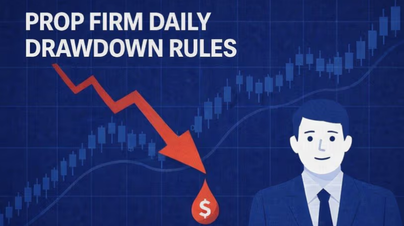
Managing Drawdown: The Key to Prop Firm Longevity
Understand the different types of drawdown rules used by prop firms and how to structure your risk management to ensure you never breach your limits.

How to Pass Prop Firm Evaluations: Strategies for Success
Discover proven strategies and psychological tips to pass proprietary trading firm challenges. Learn how to manage risk, adjust your strategy, and handle the evaluation pressure.