
Managing Drawdown: The Key to Prop Firm Longevity
Understand the different types of drawdown rules used by prop firms and how to structure your risk management to ensure you never breach your limits.
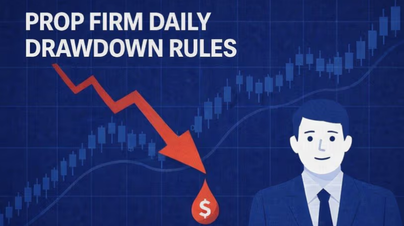
In the financial markets, drawdown is defined as the percentage or monetary drop in your trading account’s equity from its highest peak down to its subsequent lowest trough before a new peak is achieved. Simply put, it mathematically measures the depth and severity of your losing streaks over a given period of time.
01. The Definition of Drawdown
When you trade a personal retail account, a heavy drawdown is a painful, stressful experience, but you live to trade another day-you can always choose to hold onto your losing positions for weeks, deposit more margin, or simply wait for a macroeconomic recovery. You are entirely in control of how much pain your personal finances can endure.
However, in the proprietary trading industry, the rules of engagement are entirely different. Hitting your predefined drawdown limit means instant account termination. There are absolutely no second chances, no margin calls to miraculously save your account, and no waiting for the market to magically reverse in your favor. If you hit the limit by a single dollar, the risk management algorithms automatically close all your positions and lock you out of the terminal.
02. Why Drawdown is the Ultimate Metric
“Managing drawdown is not just about protecting your hard-earned profits; it is literally about survival. Your ultimate success as a trader is not measured by your best day, but by your ability to survive your absolute worst week without going bankrupt.” - Alexander Mercer
Proprietary trading firms do not evaluate your long-term potential based on how much money you can aggressively generate during a lucky winning streak. Instead, they evaluate your performance based almost entirely on how you systematically handle adversity. If your strategy regularly exposes the account to massive swings and deep drawdowns, you are considered a massive liability to the firm’s corporate capital, regardless of your ultimate profitability. A steady trader who makes 3% a month with a 1% drawdown will always be preferred over a volatile trader who makes 15% but frequently risks 8% drawdowns.
03. The Different Mathematical Models of Drawdown
Proprietary trading firms utilize several distinct mathematical models to calculate your drawdown limits. Failing to intimately understand the specific, fine-print nuances of your chosen firm’s drawdown rule is the quickest way to lose a funded account unexpectedly. You must know exactly when and how your equity is calculated.
Breakdown of Prop Firm Drawdown Rules
| Drawdown Type | Calculation Method | Difficulty Level |
|---|---|---|
| Daily Drawdown | The maximum allowable loss in a single 24-hour period (often based on starting daily balance or equity). Typically ranges from 4% to 5%. | Hard |
| Overall Drawdown (Static) | A fixed, absolute maximum loss limit calculated entirely from your initial starting balance (e.g., $100k start -> $90k hard limit). | Moderate |
| Trailing Drawdown (Relative) | The loss limit 'trails' behind your highest recorded profit peak. As you make money, your failure threshold moves up with you. | Very Hard |
These models drastically change how you must approach position sizing and trade management. A strategy that easily passes a static drawdown evaluation might immediately fail a trailing drawdown evaluation simply because of how it handles floating, unrealized profits.
04. Trailing Drawdown vs Static Drawdown
The functional difference between a trailing and static drawdown is often the deciding factor between a trader keeping a funded account for years versus losing it in the very first week.
If you have a standard $100,000 account with a 10% static max drawdown, your absolute failure point is fixed at $90,000. If you have a phenomenal week and make $10,000 in profit (your balance is now $110,000), your failure point remains firmly rooted at $90,000. You now possess a massive $20,000 buffer to absorb any future losing streaks. This static model immensely relieves psychological pressure as you grow the account.
Conversely, if you have the exact same $100,000 account with a 10% trailing drawdown, your initial failure point is $90,000. However, if you make $5,000 in floating profit during a trade (your highest peak is now $105,000), your failure point automatically trails up by $5,000 to $95,000. It never moves back down. If the trade reverses and you drop from $105,000 to $95,000, you instantly lose the account, even though mathematically you only lost the unrealized profits you just generated. Trailing drawdowns effectively punish traders for letting their winners run.
05. The Root Causes of Drawdown Failures
Very few traders lose their prop firm accounts because they have a fundamentally terrible technical strategy. If you made it to the funded stage, you clearly possess an edge. The vast majority of account terminations are instead triggered by poor risk management and a sudden emotional collapse during a perfectly normal, statistically expected drawdown phase.
Every strategy, no matter how mathematically sound, will experience a losing streak. A 40% win-rate strategy will inevitably face 6 or 7 consecutive losses eventually. Traders who have not backtested their system will interpret this normal variance as a catastrophic failure of their strategy, leading to a complete psychological breakdown.
06. Lethal Overleveraging and Panic
Lethal overleveraging is the undisputed number one killer of prop firm accounts. When you overleverage to force a profit, even a tiny, normal market pullback (such as a simple “liquidity sweep” in Smart Money Concepts or a minor news wick) can instantly breach your Daily Drawdown limit, even if your overall directional bias for the trade was ultimately correct.
Furthermore, when an account dips deeply into negative territory, a breakdown of discipline almost always ensues. Traders begin to panic, abandon all logic, widen their stop losses to avoid taking a formalized hit, or actively add positions to a losing trade (averaging down) desperately hoping for a miraculous V-shaped reversal. This emotionally driven, chaotic behavior transforms a small, mathematically manageable 1% loss into a catastrophic 5% account-breaching failure in a matter of minutes.
07. Core Principles of Defending Your Account
When you enter a severe drawdown phase and suffer consecutive, painful losses, the absolute worst thing you can possibly do is maintain or aggressively increase your risk to “win it back quickly.” Your first line of defense must always be to cut your lot size in half. Do not try to win the money back; your only objective is to survive the violent storm and give your statistical edge enough time to slowly work its way back to equilibrium.
Veto the “Revenge Trade”: Anger, frustration, and a desire to prove the market wrong are the natural byproducts of a drawdown. If you take a heavy loss that tilts your emotional state, close your trading terminal immediately. Return only when your mind is completely reset and indifferent.
Additionally, you must strictly adopt the “Fast Cut” philosophy. Never, under any circumstances, move a Stop Loss further away to give a failing trade “more room to breathe.” If the technical setup is invalidated, accept the small loss immediately. A manageable 1% loss can easily be recovered tomorrow with a single good trade; a 4.5% loss puts your entire $100,000 account on life support and will mentally cripple your decision-making for the rest of the month.
08. Tools to Prevent Drawdown Breaches
You cannot effectively manage what you do not accurately measure. Professional prop traders do not rely solely on mental math; they use external tools and software to keep track of their limits, especially their highly volatile floating intraday limits.
Always keep the proprietary firm’s official dashboard open on a separate monitor while trading. The firm’s dashboard is the final, absolute authority on your equity curve, not your MetaTrader terminal. Furthermore, if you trade on platforms like MT4 or MT5, you should highly consider installing an Equity Protection Expert Advisor (EA). You can hardcode your daily loss limit (e.g., a strict $4,800 maximum loss) directly into the EA. If your floating equity ever hits that exact number due to a massive, unexpected macroeconomic news spike or a fat-finger emotional misclick, the EA will automatically close all open trades instantly and disable the platform, saving you from breaching the firm’s hard 5% limit and preserving your account.
09. FAQs
What is drawdown in proprietary trading?
What is the difference between Daily and Overall Drawdown?
How does a trailing drawdown work?
Why do most traders fail due to drawdown?
What should I do if I enter a losing streak?
10. Conclusion
Survival always precedes profitability. In the highly structured, mathematically rigorous world of proprietary trading, your ultimate success is not measured by how much money you can quickly generate on one lucky, overleveraged Friday afternoon. It is measured exclusively by your ability to protect the firm’s corporate capital and keep your account alive during the inevitable dark days of a drawdown. You could possess the most accurate, complex trading algorithm on the planet, but it is utterly useless if you lack the emotional discipline to manage your downside limits. Protect your downside at all costs, and the upside will inevitably take care of itself over a long enough time horizon.
Latest Articles
Looking for more insights? Check out our latest guides and articles below.
Understanding Prop Firm Rules: Consistency and Profit Splits Explained
A deep dive into the fine print of proprietary firm contracts. Understand consistency rules, profit split scaling, and how to verify you'll actually get paid.

The Psychology of Trading a Large Funded Account
Transitioning from a $1,000 personal account to a $200,000 funded prop firm account requires a massive psychological shift. Learn how to handle the pressure.

Top 5 Forex Strategies for Funded Traders
Discover the most reliable and risk-averse trading strategies used by successful funded prop firm traders to maintain consistent payouts.

How to Pass Prop Firm Evaluations: Strategies for Success
Discover proven strategies and psychological tips to pass proprietary trading firm challenges. Learn how to manage risk, adjust your strategy, and handle the evaluation pressure.
What is a Prop Firm? Complete Guide to Proprietary Trading 2026
Complete guide to prop firms: what is proprietary trading, how it works, top firms 2026, risks, and strategies for success. Discover prop trading - trade $100K+ funded accounts keeping 80-90% profits with zero personal risk.